Extra Fifi
On Time and On Budget: What Glynn Purnell and Phil Innes Said About Working With Us
Ask any restaurant operator what actually keeps them up at night before a launch, and it will rarely be the colour of the banquettes.
It's the opening date that's already gone out to press. It's the contractor's variation that's landed three weeks before handover. It's the quiet arithmetic of a budget that has to stretch further than anyone planned for.
So when Phil Innes and Glynn Purnell sent us their feedback after Trillium opened, the line we sat with longest wasn't the one about the design.
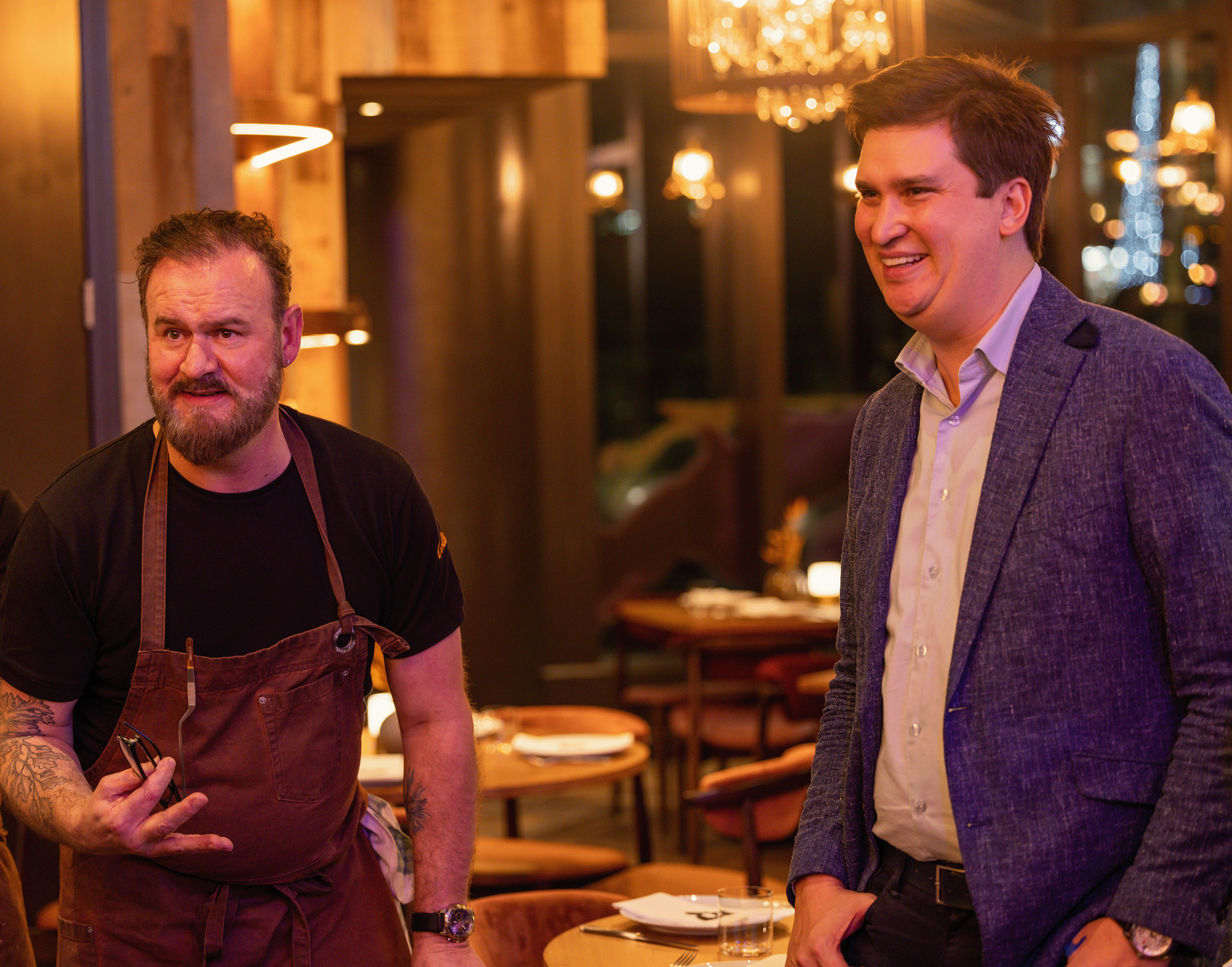
Glyn Purnell & Phil Innes
“Working with Mimi and Kendall was a great experience from start to finish.
During the initial consultation, they extracted the necessary information to bring the design to life.
They were there throughout, liaising with the contractors and ensuring everything was achieved on time and on budget.
The whole process was very easy and relaxed, and the results are unique and stunning.
We can't recommend them highly enough.”
Three things in there matter more than the compliments, and they're the three things we'd want any prospective client to understand about how we work.
"They extracted the necessary information"
A brief is rarely handed over fully formed, and it shouldn't be. Most operators know exactly how they want their room to feel and have no particular reason to know the vocabulary for it.
Our job at the first consultation isn't to present ideas. It's to ask better questions than anyone has asked before, and to keep asking until we understand the business behind the room. How you want service to move. What a Tuesday looks like versus a Saturday. Where you make your margin. What you've seen elsewhere that irritated you.
With Trillium, what came back was clear and it never really changed. Homely, not alienating. Romantic. Comfort and quality, but with guests immersed in the theatrics of the bar and the kitchen rather than seated politely away from them.
That's four ideas that could easily pull against each other. Theatre can tip into spectacle and stop feeling homely. Romance can tip into precious and stop feeling comfortable. Holding all four at once became the actual brief, and every material and layout decision that followed was tested against it.
Get that stage right and the design phase stops being a series of guesses served up for approval. It becomes a much shorter conversation, because you're both working from the same understanding.
"Liaising with the contractors"
This is the part most people don't think to ask about when they're appointing a designer, and it's where projects are won or lost.
A drawing pack is an intention. What arrives on site is a negotiation between that intention, the building's actual condition, lead times, availability and price. Somebody has to be there holding the two together, and if it isn't the designer, it usually ends up being the client, at the exact moment they're trying to recruit a team and finalise a menu.
We were on site weekly at Snow Hill throughout the build, overseeing installation and directing the trades. That meant working with the contractors day to day, directing the electricians, and coordinating every delivery that came through the door, furniture, lighting, artwork and planting included.
The value of that isn't oversight for its own sake. It's that when a question comes up on a Tuesday, it gets answered on the Tuesday, by someone who understands why the detail was drawn that way in the first place. Decisions made in that room, at that moment, are the ones that protect both the programme and the scheme.
The mezzanine
Every project has the moment where it could slip. Ours was the introduction of a mezzanine.
Adding a floor level partway through is not a small adjustment. It reopened the layout plan entirely, and we reworked it to make the most of the space while protecting flow and the practical realities of service. Circulation, sightlines, where staff move and where guests linger, all of it had to be resolved again around a change in volume.
That work cascaded. We reworked the toilet layout as part of the same exercise, which allowed us to maximise covers on the floor and protect the kitchen footprint at the same time. On a 48 cover restaurant, those metres are not decorative. They're the difference between a room that trades well and one that always feels slightly compromised.
None of it moved the opening date, and none of it moved the budget. It did take a period of intense reworking, and we'd rather say that plainly than pretend a project of this scale runs in a straight line.
"On time and on budget"
Neither of those happens by accident, and neither of them happens at the end. They're decided months earlier, in how the scheme is put together.
We develop a project around an overarching aesthetic first, so there's a clear idea holding everything together before individual decisions start getting made. Then we work closely with the team through value engineering, adapting to the budget while keeping compromises to a minimum and protecting the integrity of the scheme as a whole.
Value engineering conversations arrive on every project. The difference is whether you go into them with a scheme where everything is equally load bearing, or one where you already know which decisions carry the atmosphere and which ones are simply nice. When the concept is strong and coherent, you can move a great deal underneath it without the room losing what makes it work.
Trillium opened on the date it was announced for.
"Easy and relaxed"
Of everything in that testimonial, this is the one we're quietly proudest of.
Hospitality fit outs have a reputation for being adversarial. Designers protecting a vision, contractors protecting a margin, clients caught in between wondering why nobody will give them a straight answer. It doesn't have to run that way, and it usually only does when nobody has taken responsibility for the whole picture.
A restaurant should be an enjoyable thing to build. The people opening it are about to spend years of their lives in that room.
Talk to us about your project
We design and deliver interiors for restaurants, bars and hospitality brands across the UK, and we stay on site until the doors open. If you have a site, a date and a number you can't move, that's exactly the conversation we like having.
You can read more about the design story behind Trillium in Trillium Birmingham: Six Months In.